Decision-Based Leadership Simulation
Practice the First 30 Days of Management — Before It Counts

-
Audience: New and emerging managers transitioning into leadership roles
-
Skills Applied: Instructional design • Performance consulting • Action mapping • Scenario-based learning • Branching design • Storyboarding • UX/UI wireframing • Visual design • Interactive prototyping • Variable-based scoring • Usability testing
-
Tools Used: Articulate Storyline, Figma, Google Docs, ChatGPT, Claude, Netlify, Freepik, and Pixabay.
The Problem
Many first-time managers are promoted for their individual performance but receive little guidance on how to lead people effectively. In their first 30 days, they often struggle with unclear priorities, overcommitment, inconsistent communication, and reactive decision-making.
These small daily choices can quietly impact team morale, productivity, and retention. Without opportunities to practice leadership decisions in a safe environment, new managers may learn through trial and error—sometimes at the expense of their team’s performance and trust.
Organizations need a way for managers to build practical leadership skills before those decisions carry real-world consequences.
The Solution
I designed an interactive, scenario-based learning experience that simulates a manager’s first 30 days on the job.
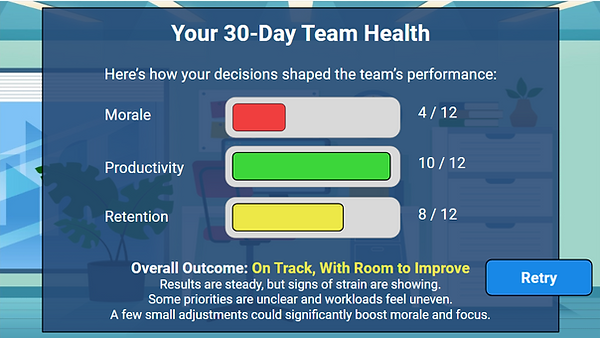
Learners navigate realistic workplace situations—team requests, deadline conflicts, performance conversations, and competing priorities—through a series of computer-based messages and decision points. Each choice carries measurable consequences that affect three performance indicators: morale, productivity, and retention.
Rather than simply presenting information, the experience allows learners to practice leadership behaviors, see the results of their decisions, and reflect on how small actions shape team outcomes over time.
This “learning by doing” approach helps bridge the gap between knowledge and performance.

The Process
I followed the ADDIE model to guide development from concept to final product:
-
Analyze: Defined the target audience (new and emerging managers) and identified common leadership challenges that directly affect team performance.
-
Design: Created learning objectives focused on behavior change and measurable outcomes rather than content recall.
-
Develop: Built a detailed storyboard and branching logic, then developed the simulation in Articulate Storyline 360.
-
Implement: Published the project for web delivery and optimized it for desktop and mobile viewing.
-
Evaluate: Conducted informal usability testing and iterated on clarity, pacing, and decision complexity.
Each phase ensured the experience stayed grounded in realistic workplace behaviors and business impact.
Action Map
To keep the training focused on performance—not information—I created an action map that identified what managers must do to succeed.
Key behaviors included:
-
Clarifying ownership and expectations
-
Setting healthy boundaries
-
Prioritizing competing work
-
Communicating transparently with the team
-
Addressing issues early rather than reactively
Every scenario in the simulation maps directly to one of these behaviors, ensuring that each decision reinforces a practical leadership skill.

Text-Based Storyboard
The storyboard served as the blueprint for all interactions and branching.
I mapped:
-
weekly scenarios (Weeks 1–4)
-
realistic Slack-style message conversations
-
three nuanced choices per decision (Best, Better, Risky)
-
consequences tied to measurable metrics
-
branching outcomes based on cumulative performance
Instead of obvious right/wrong answers, choices were intentionally designed to feel plausible and nuanced—mirroring the complexity of real workplace leadership.
Programming notes detailed how variables, triggers, and layers would calculate scores and direct learners to different endings.
Interactive Prototype
I built an interactive prototype in Articulate Storyline 360 to validate flow and functionality.
The prototype included:
-
branching scenarios
-
variable-based scoring
-
layered feedback
-
animated transitions
-
a dynamic results dashboard
Each decision updates three tracked metrics—morale, productivity, and retention—which combine to determine one of multiple outcomes. This allowed me to test whether the experience felt responsive, meaningful, and realistic before completing full development.
Full Development
The final product includes:
-
4 weeks of scenarios
-
multiple decision points with nuanced choices
-
cumulative scoring variables
-
branching consequences
-
multiple endings based on performance
-
an interactive results dashboard
Using Storyline triggers, states, and variables, I programmed:
-
dynamic score calculations
-
conditional branching
-
visual performance indicators
-
customized outcome messages
These elements transform the experience from a linear course into a simulation that adapts to each learner’s decisions.
Results & Takeaways
Key takeaways from this project:
-
Scenario-based learning increases engagement and realism
-
Nuanced decisions feel more authentic than simple right/wrong quizzes
-
Measuring outcomes reinforces the connection between choices and impact
-
Simulations can better prepare learners for high-stakes workplace situations
This project strengthened my skills in performance consulting, branching design, and building complex interactive experiences in Articulate Storyline 360. It reflects my approach to instructional design: practical, human-centered learning that drives real-world results. In the process, I learned a lot, and I'm looking forward to my next project!